Ending The "Which Trip Are You Referring To?" Dance
Pavel Pratyush
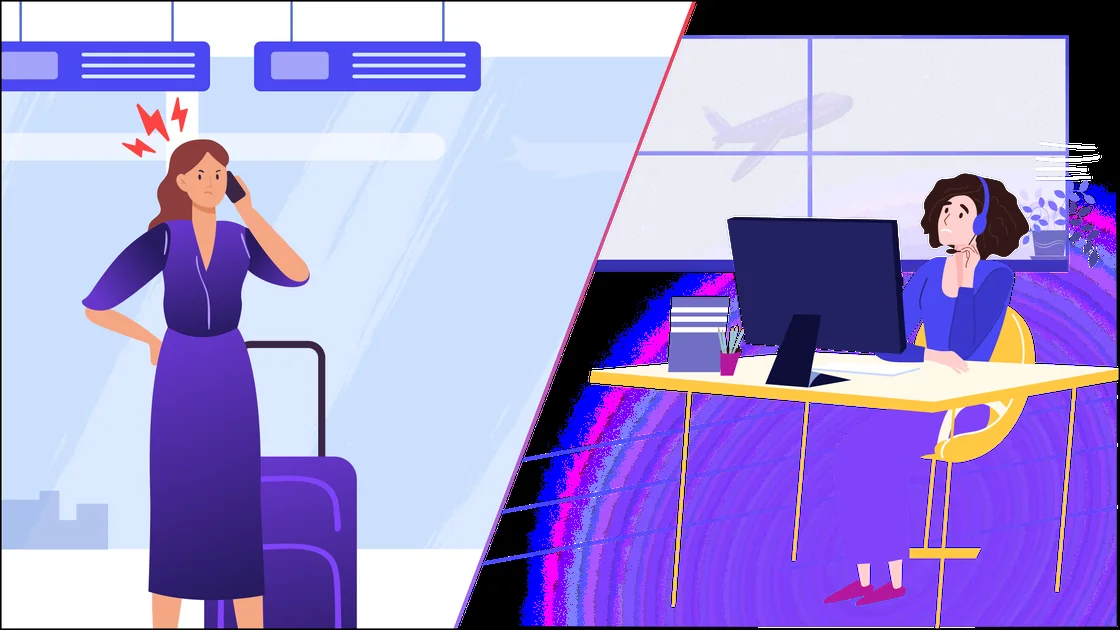
For years, one of the most frustrating — and time-consuming — parts of traveler support has had nothing to do with actually solving problems.
It’s been the back-and-forth.
“Which trip are you referring to?”
“The one to Paris.”
“You have two trips to Paris.”
“The later one.”
“Can you confirm the booking reference?”
Whether this happens over email, chat, WhatsApp, or a phone call that starts with IVR purgatory, the outcome is always the same. Time gets wasted. Patience runs out. And the real issue is delayed before it even starts.
My team decided to eliminate this entirely.
The Problem: When Context Is Missing
Historically, both chatbots and human advisors have been forced to rely on rigid identifiers — booking references, ticket numbers, exact dates — just to understand which reservation a traveler is talking about.
If the traveler didn’t have that information handy (or didn’t know what the system expected), the conversation stalled. Especially as most “AI chatbots” made things worse by firing off long chains of clarifying questions. But even the best human advisors, who knew all their VIP travelers birthdays, were pushed into detective mode.
The result was predictable: too much back-and-forth, slower resolutions, and frustrated travelers.
The Breakthrough: Understanding Context When It Isn’t Explicit
The insight was simple, but hard to execute: travelers already provide enough context — just not in the structured way systems expect.
Acai’s AI Travel Agent now retrieves the right reservation automatically by interpreting context from the conversation itself. Casual mentions of dates. Destinations dropped mid-sentence. Channel history. Past interactions. Behavioral signals.
Instead of interrogating the traveler, the system pieces these signals together and maps them to the correct booking.
Once the reservation is identified, the AI can:
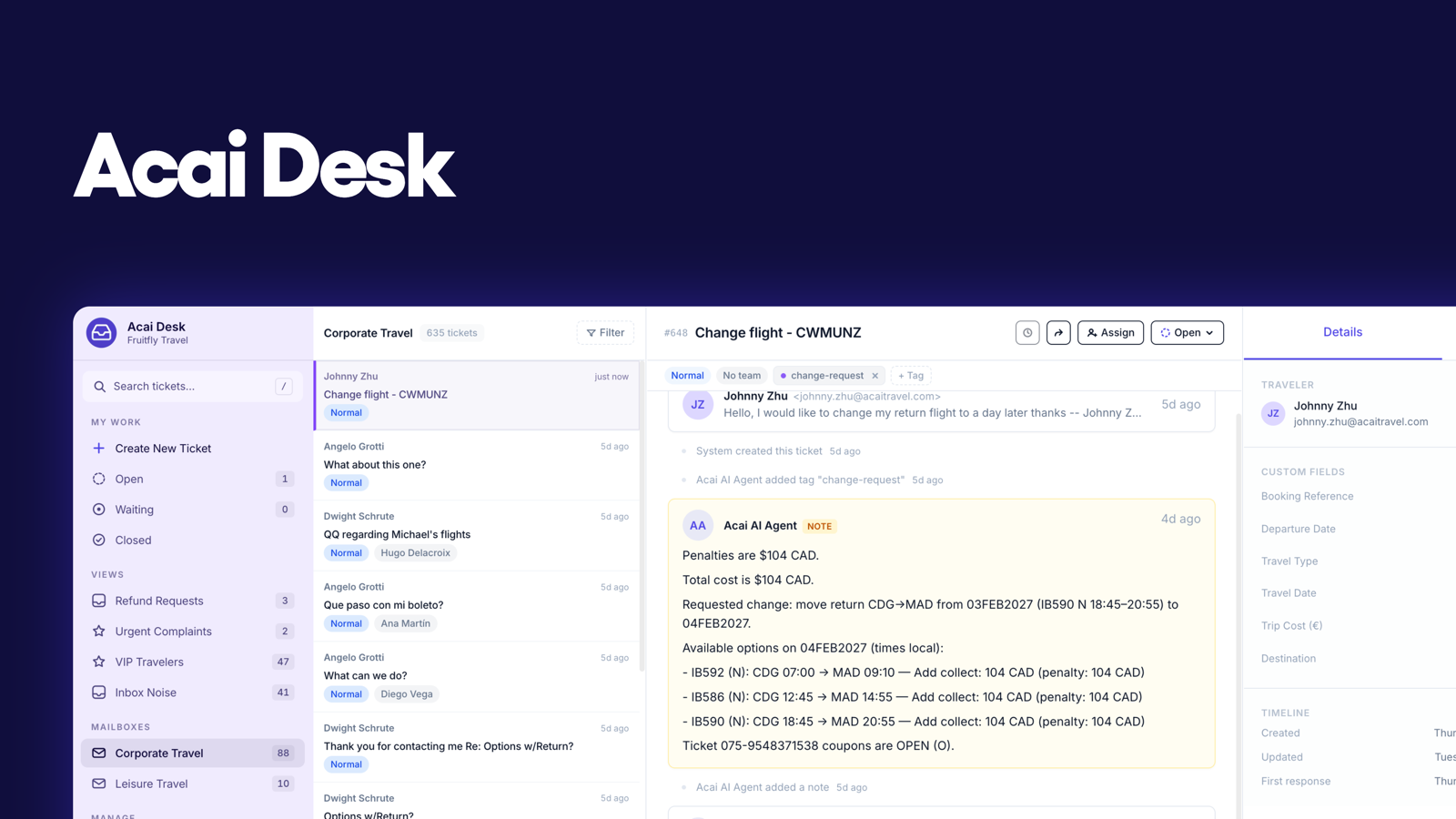
Engage the traveler directly in a meaningful, informed conversation ready to take action on their behalf
Or instantly prep a human advisor with the correct booking already open
No guessing. No IVR maze. No awkward clarifications.
How It Came to Life: Alberto & Dani’s Obsession
This feature didn’t come from a single brainstorm or customer request. It came from watching the same failure point happen again and again.
“Nobody asked us to build this,” said Alberto Pascual Corpas, Senior Backend Engineer. “We just kept seeing the same thing break — not because customers didn’t care, but because systems forced agents to ask these questions first.”
Early versions focused on obvious signals. Then more subtle ones. Then combinations. Then edge cases.
“Every time we thought it was ‘good enough,’ we found another way travelers naturally describe their trips,” added Dani Perez, Engineering Lead. “So we taught the AI Travel Agent to understand more on how humans talk, and not rely on how databases want to be queried.”
What started as a basic matching engine evolved into a learning system — one that improves with every real interaction. Honestly, we underestimated how messy and inconsistent real traveler language would be, and that forced the team to build something much more flexible.
Over 75% Accuracy — and Climbing
Today, Acai’s AI Travel Agent correctly identifies the right reservation in over 75% of conversations, and that number continues to increase as the system learns from real-world usage.
Crucially, this works:
For travelers with full profiles, including active and historical reservations
And for travelers without an existing profile at all (so imagine HCPs, guest travel fulfillment like our partners at EmPath do)
We’re no longer limited to traditional identifiers. Context fills the gaps, even when information is partial, vague, or implicit. When the AI Travel Agent is unable to correctly identify the reservation, we still have all the fallback mechanisms for handoff to a human advisor, etc.
Real Impact: Better Experiences, Measurable Gains
Once you stop burning the first few minutes just figuring out which trip someone means, everything else gets easier:
Faster resolutions
Less agent fatigue
Happier travelers
Across Acai customers, this translates into 5–20 basis point increases in CSAT. Not because of flashy automation, but because we removed some friction at the very start of the conversation — where it never should have existed in the first place.
What This Means for the Future
Look, travel support shouldn’t feel like an interrogation. It should feel like a conversation — one where the system already understands enough to help.
By eliminating the need to first figure out “which trip,” Acai’s AI Travel Agent now allows both AI agents and human advisors focus on what actually matters: solving problems, building trust, and delivering better experiences.
If your support experience still starts by asking travelers to dig up a booking reference, you’re designing for systems — not for people.
And we’re not done.